
Summary
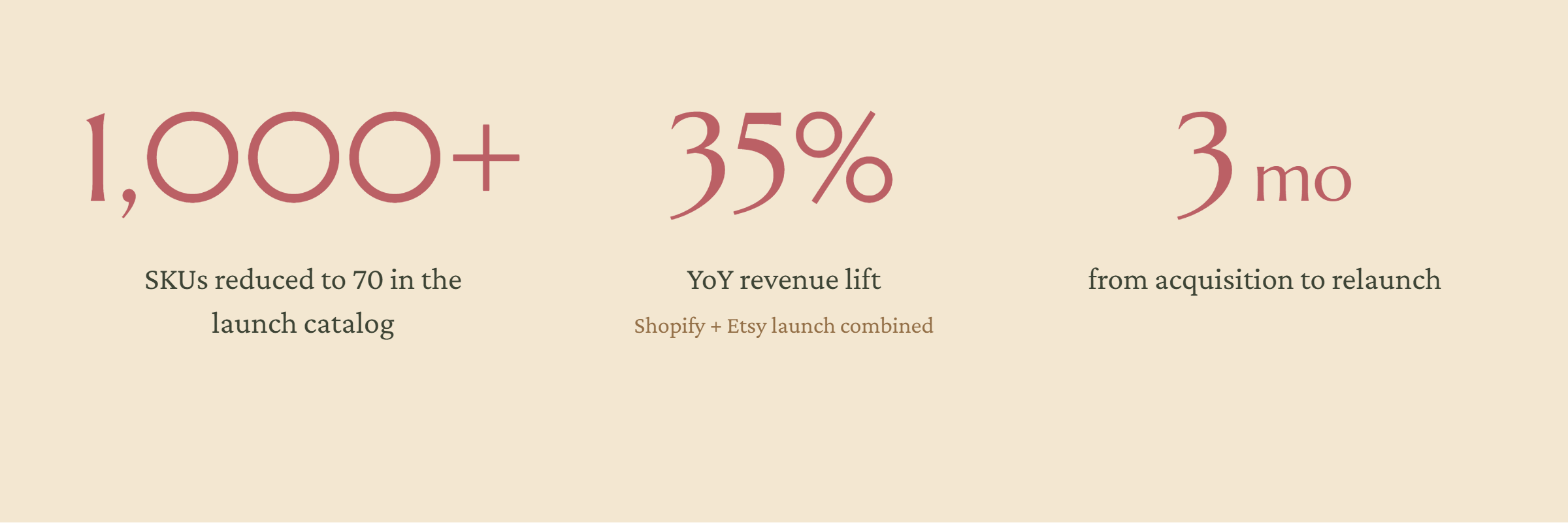
How I relaunched an acquired brand by starting small: cutting 1,000+ SKUs to a 70-design MVP catalog built from the inventory and resources we already had, then adding processes and a new Etsy channel step by step, driving 35% YoY revenue growth.
The problem
At Direct Promotions, we'd started brands from scratch before. We'd never acquired one. You'd think acquisition would be the easier path — you inherit customers, sales history, a brand with a story. But acquired businesses are more delicate, not less, because someone else's life's work is now in your hands.
Silly Phillie is a 30+ year-old baby gift brand operating in South Brooklyn. The previous owners worked closely with us through the handoff, trusting our team to cradle their baby safely. On my plate as ecommerce manager: operations, marketing, and a catalog of over 1,000 SKUs spanning four decades of design decisions made by people who weren't us.
Honestly, no one internally wanted to touch this brand. The complexity was real, the emotional stakes were real, and the easier choice would have been to let it sit. If I wanted this acquisition to succeed, I had to find people to get on board myself.
My Process
I started with the relationships. Our procurement lead and production manager became my closest partners — without them, none of the next steps would have worked.
Then I built an MVP catalog. Trying to relaunch all 1,000+ SKUs at once would have buried us. Instead, I worked backward from the data:
I pulled historical sales data and identified the top 10–20 sellers and ~30 additional decent performers as the foundation
I worked with production to map what we already had inventory for, what we could procure below normal minimums (lower risk), and what was worth going all-in on based on sales performance
I separated the top 100 into 5 piles: must-have, should-have, could-have, not necessary, and need-to-offload
I deliberately excluded seasonal items from the launch so we could focus on the evergreen baby shower market, then seasonal expansion later as a "new and improved" campaign.
The trickiest pile was the need-to-offload one, hard goods like rattles and baby toys we'd acquired with the business. For those, I worked with the team to either sell them through as-is or reimagine best-selling designs to incorporate the inventory we needed to clear. That meant the cull wasn't just about subtraction, it was about creative reuse of what we'd inherited.
After three months of research, pricing sheets, and production meetings, we settled on 70 designs. That's what we relaunched with.
The result
The relaunched assortment was lean enough that we could also open a new sales channel on Etsy, something that wouldn't have been operationally viable with the original 1,000+ SKU catalog, in the given timeframe. Together, the Shopify relaunch and the new Etsy channel produced a 35% year-over-year revenue lift in the first month after launch.
The launch catalog is still in market today.
What I learned
Acquired brands aren't just inventory and customer lists. They're the cumulative judgment of the people who built them, and that judgment deserves respect even when you're cutting 93% of it. The cull worked because we were rigorous about the data, but it succeeded because we were thoughtful about the legacy.
I also learned that hard decisions get easier when the framework is explicit. Must / should / could / not necessary / offload isn't a fancy model — but having those buckets named meant our production meetings stopped being debates and started being sorting exercises. The structure did the heavy lifting; we just had to be willing to use it.
The whole project was an exercise in cradling something fragile while still being willing to make sharp decisions about it. Both can be true at the same time.